

Liquid Biopsy Guide: Monitoring ctDNA, CTC, and RGCC Between Scans

Medical Disclaimer: Heal Navigator is an independent clinic directory and educational resource, not a medical provider. The content on this page is for informational purposes only and does not constitute medical advice. Always consult with your qualified healthcare team before pursuing any treatment protocol.
If you’ve ever counted down the days until your next scan wondering if the cancer is gone, shrinking, or quietly growing you’re not alone. That anxious waiting period has a name among patients: scanxiety.
“Let’s be honest,” says Dr. Gez Agolli. “There’s nothing easy about cancer, it disrupts your life physically, emotionally, and spiritually. Waiting between scans can cause real fear and anxiety.”
For decades, scans were the only way to know if treatment was working or if cancer had returned.
But now, that’s changing.
New blood-based monitoring tools, often called liquid biopsies, can detect cancer activity months before imaging, using just a simple blood draw.
These tests can offer reassurance between scans or help doctors act sooner if something changes.
Before we dive in, here’s what you should know at a glance:
Key Takeouts
- Liquid biopsy tests detect cancer activity between scans using a simple blood draw.
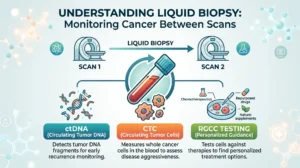
- ctDNA tests analyze tumor DNA fragments to spot early signs of recurrence or treatment response.
- CTC tests detect whole cancer cells in the bloodstream to understand how active or aggressive the disease may be.
- RGCC tests do further testing of your cells against multiple therapies to find which treatments might work best.
- Always discuss results and timing with a qualified oncologist or integrative practitioner familiar with these tests.
What Is a Liquid Biopsy?
A liquid biopsy detects cancer activity by analyzing DNA fragments or whole cancer cells circulating in your blood. It provides a real-time snapshot of what’s happening at the molecular level, sometimes before tumors are visible on a scan.
When tumor cells grow and die, they release circulating tumor DNA (ctDNA) and circulating tumor cells (CTCs) into the bloodstream. By capturing and analyzing these, labs can identify whether cancer activity is present or changing.
The term liquid biopsy simply refers to any blood-based test that detects cancer activity — including ctDNA, CTC, and RGCC.
What is the difference between a liquid biopsy and a tissue biopsy?
Liquid biopsy vs. tissue biopsy
Because it’s non-invasive and repeatable, a liquid biopsy is ideal for:
- Ongoing monitoring after treatment
- Tracking whether a therapy is working
- Detecting recurrence earlier than imaging
In short: a liquid biopsy doesn’t replace scans, it complements them. Together, they give doctors a clearer picture of both where and how active your cancer might be.
“These tests give your practitioner and you the tools to make better decisions,” explains Dr. Agolli. “Use this technology to your advantage.”
How Do Liquid Biopsies Detect Cancer Activity in the Blood?
A liquid biopsy works by looking for biological “breadcrumbs” that cancer cells leave behind.
When tumor cells grow, divide, or die, they shed bits of DNA and sometimes whole cells into the bloodstream.
Using advanced technologies, labs can detect even one tumor fragment among 100,000 normal DNA fragments, making these tests remarkably sensitive.
These tests focus on two main signals:
- ctDNA (circulating tumor DNA) – Genetic fragments carrying cancer-specific mutations or methylation patterns.
- CTCs (circulating tumor cells) – Intact cancer cells that have detached from tumors and entered the bloodstream.
These tests give patients something many have long wanted, visibility between scans.
“When patients ask me if they can do something between scans, these are often the first tests I discuss,” says Paityn Thorne, Head of Patient Care at Heal Navigator.
While scans show where cancer is, liquid biopsies show whether it’s active, often earlier, with just a vial of blood.
What is a Circulating Tumor DNA (ctDNA) test?
A ctDNA test measures tiny fragments of tumor DNA circulating in your blood. By tracking these fragments, doctors can monitor microscopic cancer activity and spot early recurrence often months before scans detect changes.
Unlike imaging, which shows location, ctDNA reveals activity.
“This is what we call precision,” says Dr. Agolli. “In the past, you’d wait for scans. Now, with ctDNA testing, you can take proactive steps rather than waiting and guessing.”
What ctDNA Tests Show?
- If tumor DNA is still detectable after treatment
- Whether cancer activity is increasing or decreasing
- Early warning signs of recurrence
- In some cases, new genetic mutations that suggest resistance or progression
When Should You Consider ctDNA Testing?
- After treatment, to confirm remission or detect minimal residual disease
- During remission, for peace of mind between imaging
- During treatment, to evaluate therapy response
- When exploring integrative or precision oncology, to guide personalized care
Most patients repeat ctDNA testing every 3–6 months, depending on their cancer type, risk level, and stage.
What Is a Circulating Tumor Cell (CTC) Test?
A Circulating Tumor Cell (CTC) test looks for whole cancer cells that have entered the bloodstream from a tumor. By counting and analyzing these cells, it provides clues about how aggressive a cancer might be and whether it’s spreading.
“Instead of just waiting to see if a tumor grows on a scan,” Dr. Agolli says, “a CTC test lets us understand how the disease is behaving in real time.”
While ctDNA measures genetic fragments, CTC testing focuses on intact tumor cells that have detached from the primary tumor or metastases.
What CTC Tests Show?
- The number of tumor cells circulating in the blood (higher counts often indicate more active disease)
- How aggressive a cancer may be, based on cell type and behavior
- Clues about metastatic potential or how well treatment is working
- In some research settings, molecular details of the cells that could guide targeted therapies
When Should You Consider A CTC Test?
- When you’re in advanced or metastatic stages and want more detail about disease behavior
- To track treatment response or resistance over time
- Alongside ctDNA testing, to combine genetic and cellular insights
ctDNA vs CTC: What is the Difference?
What is the RGCC Test?
An RGCC test (Research Genetic Cancer Center) analyzes your blood to identify which treatments, medications, and natural compounds may work best against your specific cancer cells.
It’s a precision-medicine test designed to guide therapy choices, not just monitor disease activity.
“The RGCC test goes further,” says Dr. Agolli. “It tells you which medications, chemo included, and even which repurposed drugs, herbs, or nutrients are most sensitive for your cancer cells. It gives your practitioner the tools to build a personalized plan rather than relying on protocol medicine.”
How does it differ from ctDNA or CTC testing?
While ctDNA and CTC tests focus on what your cancer is doing, RGCC testing focuses on how to treat it most effectively.
Using a blood sample, RGCC isolates circulating tumor cells, cultures them, and exposes them to a wide range of substances including chemotherapy drugs, immunotherapies, repurposed medications (like Ivermectin or Mebendazole), and plant-based compounds.
“While ctDNA and CTC focus on what your cancer is doing, RGCC helps identify which treatments might work best for you including repurposed drugs and natural compounds,” explains Dr. Gez Agolli.
What Does the RGCC Test Show?
- Drug sensitivity: which chemo or targeted drugs your cells respond to
- Natural and repurposed compounds that inhibit tumor growth
- Tumor activity markers such as proliferation rate and apoptosis (cell death) potential
- Immune-related findings that can guide integrative or supportive care
What to Know Before You Take The RGCC Test
- Timing matters: most practitioners recommend waiting 14–21 days after chemotherapy or major supplements to ensure accurate results
- Only interpret results with a trained RGCC practitioner familiar with the report’s complexity and context
- Typical turnaround time: 2–3 weeks
- Cost: $1,000 – $3,000+, usually self-pay
RGCC testing can be a valuable complement to ongoing care, especially when designing a personalized treatment plan.
“I always tell patients,” adds Dr. Agolli, “when you don’t test, you just guess, and when you guess, you make mistakes. These tools help you become proactive, not reactive.”
Which Test Should You Choose?
ctDNA vs. CTC vs. RGCC
The right test depends on your goals whether you want to monitor for recurrence, track treatment response, or personalize your next phase of care.
Each test provides a different layer of information about your cancer’s behavior and how your body is responding.
Your choice depends on your goal:
- Monitoring: Choose ctDNA or CTC testing.
- Treatment planning: Choose RGCC.
- Peace of mind: Regular ctDNA monitoring offers reassurance between scans.
“Choosing depends on your goals: monitoring versus planning, and what stage you’re in.” — Dr. Gez Agolli
Each test offers a unique window into your cancer’s behavior. Here’s how they compare side by side:
How Often Should You Retest?
- ctDNA: Every 3–6 months during remission or ongoing treatment
- CTC: Every 3–6 months for active or metastatic cases
- RGCC: Every 6–12 months, or before changing therapies
Testing too soon after chemo or supplements may affect accuracy, confirm timing with your provider.
How Should You Prepare for These Tests?
Preparation depends on the type of blood test you’re doing, but a few simple steps can help ensure accurate results:
- Stay hydrated: Drink plenty of water the day before and morning of your test. Proper hydration helps with blood draw and sample quality.
- Avoid strenuous exercise for 24 hours before testing, as it can temporarily alter some biological markers.
- Follow medication and supplement instructions: Some treatments — including chemotherapy, targeted drugs, or even high-dose antioxidants — can influence test accuracy. Ask your provider if anything should be paused beforehand.
- Time your test carefully: For ctDNA and CTC, many practitioners recommend waiting 2–3 weeks after surgery, chemo, or radiation to avoid false readings from temporary cell death. For RGCC, aim for 14–21 days after chemotherapy or strong supplements for the most reliable results.
- Eat normally unless advised otherwise. These tests typically don’t require fasting.
How do you order these tests?
Most liquid biopsy and RGCC tests can be ordered through your oncologist, an integrative cancer clinic, or directly through certain labs that work with physician oversight. The process varies slightly depending on the type of test:
For ctDNA and CTC tests:
- Many conventional oncologists already partner with major diagnostic labs like Natera (Signatera) or Guardant Health (Guardant Reveal).
- If your oncologist doesn’t offer these tests, you can ask whether they’ll authorize one through a third-party provider.
- In some cases, you can contact the lab directly, they’ll coordinate the blood draw through a local collection center and send results to your physician.
For RGCC testing:
- RGCC tests must be ordered through a registered practitioner (MD, ND, or integrative physician) familiar with the process.
- After a brief consultation, the practitioner will issue a test requisition form and coordinate shipping to the RGCC central laboratory in Greece.
- Blood is drawn locally (often at a clinic or mobile phlebotomy service) and shipped overnight for processing.
What to ask before ordering an RGCC test
- How will results be interpreted, and by whom?
- How long does it take to receive results?
- Are there special preparation steps (e.g., medication or supplement pauses)?
- What will we do differently depending on the results?
If you’re not sure where to begin, you can speak with a Heal Navigator advisor, who can connect you to providers experienced in liquid biopsy, ctDNA, CTC, and RGCC testing. We’ll help you understand your options and ensure the test you choose aligns with your stage, treatment history, and goals.
Get in touch with us here.
How Much Do These Tests Cost?
Costs can vary widely depending on the lab, region, and whether your test is covered by insurance. Below are approximate U.S. self-pay ranges, based on recent research and provider information:
- ctDNA tests: ctDNA tests typically range from $300–$1,000 depending on the lab and scope of analysis.
- CTC tests usually cost $350–$1,500, depending on whether the analysis includes a simple cell count or detailed molecular profiling.
- RGCC tests generally cost $1,000–$3,000, depending on the specific test panel, blood collection method, and practitioner fees.
These estimates don’t include additional costs such as blood draw, physician consultation, or shipping. Insurance coverage for RGCC testing remains limited and varies by policy.
Checking Coverage and CPT Codes
If you plan to submit for insurance reimbursement, ask your provider or lab for the CPT (Current Procedural Terminology) code associated with your test.
Your insurance company can use this code to determine if the service is eligible for pre-authorization or partial reimbursement.
Some major ctDNA labs (such as Natera and Guardant Health) may assist with insurance paperwork or offer financial assistance programs for patients paying out-of-pocket.
Are These Tests Reliable? What Patients Should Know About Accuracy and Limitations
While these tests are powerful, they’re not perfect, and they don’t replace scans or clinical judgment.
Accuracy and Limitations
- ctDNA sensitivity: 95–98% for many solid tumors
- CTC sensitivity: lower (cells are rare), but helpful in metastatic tracking
- Results can be affected by recent surgery, infection, or inflammation
- False negatives are possible if tumors aren’t shedding detectable DNA
That’s why results should always be interpreted alongside scans and clinical context by a trained provider.
“Nothing in medicine is 100 percent,” says Dr. Agolli, “but these tools are highly sensitive and incredibly valuable for catching recurrence early.”
How Do You Ask Your Doctor About These Tests?
If your oncologist hasn’t mentioned these options, here are some helpful questions:
- “Would a ctDNA test provide useful information between scans?”
- “Could it help us detect recurrence earlier?”
- “If ctDNA is positive but my scan is clear, what would our next steps be?”
- “How might RGCC or CTC testing fit into my care plan?”
“Many oncologists are starting to adopt ctDNA and CTC testing,” says Dr. Agolli. “But sometimes, patients have to bring it up first. Don’t be afraid to educate your doctor, most are open once you ask.”
You can also reach out to Heal Navigator’s Care Team, who can connect you with integrative oncologists familiar with these tools.
How Liquid Biopsy Tests Help You Monitor Cancer
No one should have to live in constant fear between scans. These blood-based tests aren’t just about data, they’re about peace of mind.
Knowing what’s happening inside your body in real time can turn anxious waiting into empowered awareness.
Whether you’re monitoring for recurrence, fine-tuning your treatment, or simply wanting reassurance, you don’t have to navigate it alone. At Heal Navigator, we’re here to help you understand your options, connect with trusted professionals, and make informed choices that bring both clarity and hope to your journey.

