

The Hulda Clark Protocol: 3 Core Elements and What the Science Shows
Medical Disclaimer: Heal Navigator is an independent clinic directory and educational resource, not a medical provider. The content on this page is for informational purposes only and does not constitute medical advice. Always consult with your qualified healthcare team before pursuing any treatment protocol.
Maybe you’ve heard that the Hulda Clark protocol is a cure for all types and stages of cancer.
It’s a bold claim, and one that continues to circulate across forums, videos, and alternative health communities.
If you’re looking into it, there’s a good chance you’re searching for something more. For many patients, this isn’t a first step — it’s something they come across after being told their options are limited, or when the standard path doesn’t feel like enough.
The Hulda Clark protocol is often described as a complete system, built around the idea that cancer is caused by parasites and can be treated by eliminating them from the body.
But what’s actually behind these claims?
In this article, we’ll walk through what the protocol is, why some patients are drawn to it, and how to think about it within a safe, evidence-informed approach to care.
Who Was Hulda Clark?
Hulda Clark was an innovative albeit controversial figure in alternative medicine who rose to prominence in the 1990s.
Trained as a physiologist, she became widely known for her belief that parasites, toxins, and environmental pollutants were the root cause of most diseases, including cancer.
Her books, devices, and detox regimens attracted a devoted following, particularly among people seeking more natural or self-directed approaches to healing.
At the same time, Dr. Hulda Clark’s theories were rejected by the scientific and medical communities because they were not supported by credible clinical evidence.
She also faced legal and regulatory challenges related to practicing medicine without a license and making unsubstantiated treatment claims. Even so, Clark remains an influential name in alternative health circles, and interest in her ideas continues online today.
What Is the Hulda Clark Protocol?
The Hulda Clark protocol is an alternative health regimen built around the idea that the body can heal itself if harmful pathogens and pollutants are removed.
At the center of Dr. Clark’s protocol was her theory of a “universal parasite,” which she identified as Ascaris lumbricoides.
She believed this parasite, when activated by environmental toxins or pollutants, could move throughout the body and contribute to a wide range of illnesses, including cancer.
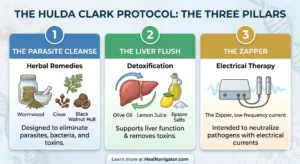
In practice, the Hulda Clark protocol combines several elements:
- Cleansing
- Herbal remedies
- Organ detoxification
- Dietary restrictions
- Toxin avoidance
1. The Hulda Clark Parasite Cleanse
One of the most recognizable parts of the regimen is the parasite cleanse, which typically includes black walnut hull, wormwood, and clove, sometimes called the “Clark trio.” These herbs were believed to target different stages of a parasite’s life cycle and were often taken in staggered doses over time.
2. The Hulda Clark Liver Cleanse (Liver Flush)
The protocol may also include a Hulda Clark liver cleanse or Hulda Clark liver flush, usually involving ingredients such as olive oil, lemon juice, and Epsom salts, along with broader recommendations to avoid processed foods, artificial additives, household chemicals, and non-distilled water.
3. The Zapper
One of the more controversial aspects of the protocol is the use of an electronic device known as the zapper. Clark claimed the zapper emitted low-frequency electrical currents that could kill parasites, bacteria, viruses, and fungi without harming healthy human cells.
According to her theory, different pathogens responded to different frequencies, and the device was used by placing electrodes on the wrists, hands, or ankles so electrical current could pass through the body.
Hulda Clark and Cancer: What the Research Shows
There is currently not enough credible clinical evidence that the Hulda Clark protocol, or parasite cleansing more broadly, can treat or cure cancer. Leading medical institutions describe cancer as a disease driven by genetic mutations and complex cellular processes, not parasites or toxins in the way the protocol suggests.
At the same time, some of the ideas behind Clark’s protocol do intersect with areas of legitimate scientific research. A small number of infectious agents, including certain parasites, have been linked to specific cancers.
For example, infection with Schistosoma haematobium is associated with bladder cancer in endemic regions.
Some of the protocol’s herbal components have also been studied individually.
Wormwood contains compounds such as artemisinin and artesunate, which have shown anti-cancer activity in laboratory and preclinical studies.
Clove contains eugenol, a compound that has demonstrated antioxidant, antimicrobial, and anti-cancer properties in laboratory settings.
Some of the protocol’s concepts draw on longstanding traditions in herbal medicine, but as of today, they have not been validated as effective cancer treatments in modern clinical research.
Risks and Safety Considerations
One reason protocols like this can be confusing is that they are often described as “natural,” which can make them seem inherently safe. But natural does not always mean harmless.
The biggest concern is often not one individual herb or product, but how and when the protocol is used.
When an unproven approach is pursued without medical oversight the consequences can be serious.
Delays in effective care, interactions with medications, electrolyte imbalances, dehydration, and the physical strain of aggressive detox regimens are all real possibilities.
Even substances like wormwood, black walnut, or concentrated herbal tinctures can have physiological effects, especially in people already undergoing chemotherapy, immunotherapy, radiation, or surgery. The same is true for devices like the zapper.
An Integrative Approach: Moving From Alternative to Complementary
In practice, most patients are not choosing between conventional and alternative medicine as two completely separate paths. Alternative treatment is often referred to as complementary care precisely because it is intended to be used alongside standard medical treatment, not in place of it.
Some patients explore complementary approaches while undergoing chemotherapy, radiation, immunotherapy, or surgery. Often, the goal is to manage side effects, improve quality of life, or feel more actively engaged in the healing process.
In that context, curiosity about protocols like the Hulda Clark protocol is understandable. But it is critical that any exploration be guided by evidence, safety, and informed decision-making.
That means evaluating whether a supplement, cleanse, or alternative protocol could interfere with treatment, worsen symptoms, or delay necessary care. It also means helping patients separate what is promising, what is unproven, and what may be risky.
This is where medical supervision plays a critical role. Patients do best when they have space to ask questions openly and explore options with practitioners who understand both conventional oncology and supportive care.
The goal is not simply to say yes or no to every alternative therapy, but to help patients make decisions that are thoughtful, safe, and grounded in the reality of their diagnosis.

