

Stage 4 to Clear Scans in 90 Days: Karen & Jeff’s Story
After years of headaches, Karen finally went in for an MRI. The scan revealed something in her neck. A biopsy confirmed lymphoma. Then, as doctors scanned the rest of her body to see whether the lymphoma had spread, they found something else: suspicious lesions on her liver.
A liver biopsy brought a second, even more frightening diagnosis: stage 4 melanoma, metastasized from a cancer spot on her back.
“There were 20 spots, at least,” Karen’s husband, Jeff, recalls.
Suddenly, Karen was facing not one cancer diagnosis, but two!
“So it was stage four when we found out,” Karen says. “That was very scary.”
From the beginning, Jeff and Karen faced the diagnosis as a team. Karen was the patient, but Jeff, a registered nurse, quickly stepped into the role of researcher, advocate, organizer, and protector – determined to understand every option available and leave no stone unturned.
When “Watch and Wait” Isn’t Enough
For the melanoma, doctors recommended immediate immunotherapy. Karen had a port installed and began treatment with two immunotherapy drugs.
At the same time, she and Jeff decided to incorporate an integrative approach, including fenbendazole and ivermectin inspired by the Joe Tippens protocol.
The melanoma responded quickly. But when it came to the lymphoma, the recommendation was very different: watch and wait.
What? Why?
Because the lymphoma was not yet causing major symptoms, the medical team advised holding off on treatment. That did not sit right with Jeff.
“I just didn’t like the fact that we were putting the lymphoma on hold,” he explains. “To be told, hospital protocol is, if it’s not bothering you, it’s not affecting your life, then we’re not treating it. And I didn’t like that idea. I wanted it gone.”
As a registered nurse, Jeff understood the medical system. But he also understood how serious the situation was. With stage 4 melanoma in the liver and lymphoma still present, he felt they could not afford to be passive.
“I wanted to really think outside the box,” he says. “I wanted every option available.”
Building an Integrative “Plan B”
Jeff began researching late into the night, printing studies, saving test results, asking questions, and building binders full of notes.

Jeff's research binders, he printed everything he could

One of two research binders that Jeff put together
He began looking into supplements, repurposed medications, cannabis-based approaches, and protocols other patients had used, including the Joe Tippens protocol.
“It was exhausting at times,” he admits. “I put everything I had into it.”
His search eventually led him to Heal Navigator, where the couple connected with two members of the integrative oncology consultants team, PA Madhavi Parikh and Janna Champagne. Together, they explored additional integrative options, including cannabis Fenbendazole, , and supplement strategies.
“One thing cascaded,” Jeff says. “Every door that we needed opened.”
Karen trusted him completely. “I know he did a lot of research, spent many hours doing stuff, and his medical knowledge… I just totally trusted Jeff,” she adds. “I felt completely comfortable with what we were doing”
Pushback From Conventional Medicine
But not everyone was supportive of their decision to combine conventional immunotherapy with repurposed medications, supplements, and other integrative approaches.
Jeff remembers one doctor, in particular, who strongly criticized their plan.
“She was very angry with me trying all this,” he recalls. “She said, ‘It’s useless. It doesn’t work.’”
According to Jeff and Karen, the doctor scolded them for what they were doing and told them Karen had six months to live at best.
Still, they chose to continue with the plan they had built.
“We just kept doing the protocols that we had in place and kept moving forward,” Jeff says.
Faith, Family, and a Plan

Karen and Jeff with their granddaughter at a cheer competition
Refusing to be discouraged, Jeff and Karen leaned even more heavily on what had been carrying them all along: the growing network of support around them as well as their faith.
“I’m a firm believer in Jesus Christ, and have been for years,” Jeff explains. “We did a lot of praying, and we felt that our community of church family prayed for us too. I believe it made a huge difference.”
They also leaned on each other. Jeff took on the research, the protocols, the binders, and the questions. Karen focused on following the plan and staying steady.
“I wanted to try everything,” Jeff says. “As long as she was willing to do it, Karen was willing to take it on, then we were going to do it.”
Karen began a combination of immunotherapy treatments and Fenbendazole and Ivermectin according to the Joe Tippens Protocol to treat both the melanoma and the lymphoma.
The Results: “The 20 Spots Were Gone”
After three immunotherapy treatments, combined with the other protocols Jeff and Karen had put in place, Karen had another PET scan.
The results were stunning.
“All the spots were gone in three months,” she recalls.
Jeff remembers the moment clearly.
“We were floored,” he says. “The 20 spots were gone.”
Both cancers showed no evidence of disease after roughly three months of treatment. Karen continued with immunotherapy for a period afterward because her doctors wanted her to follow the protocol and reduce the risk of recurrence. She completed 11 treatments in total, and the spots did not return. Nor has the lymphoma.
Jeff is careful not to claim that one single intervention was responsible.
“It’s hard to know which worked,” he points out. “I believe that all of it working together helped. I think we cleared the road of junk in her body by what we did with the protocols that we put in place and allowed the other medication, the more conventional stuff, the Opdivo and the others that she was on, to work the way it was supposed to.”
Looking back, he describes the process as a series of doors opening at exactly the right time.
“We were really blessed,” he says. “I keep saying it. I just felt like we were led in the right direction.”
Life After Stage 4
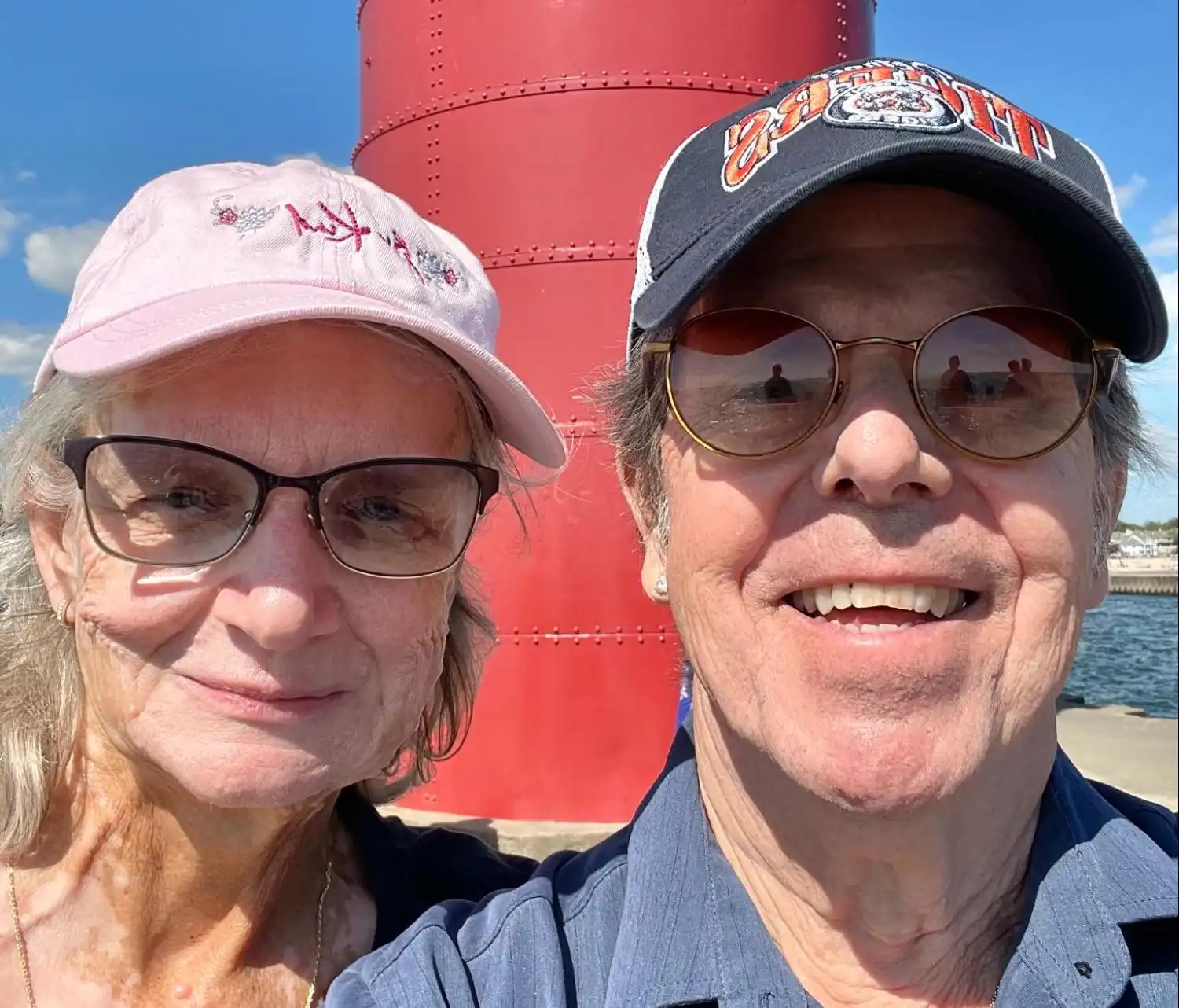
Karen and Jeff on one of their many adventures after overcoming two cancer diagnosis

Jeff and Karen who is now NED after battling 2 cancer diagnosis
Today, Karen is back to regular life.
She works part-time caring for a veteran, exercises every morning on a stationary bike, takes walks when Michigan weather allows, and continues to focus on staying healthy.
“I’m just going on with normal life, really,” she says.
She and Jeff have reduced some of the supplements they were using earlier in the process, but they continue to follow parts of the plan they believe helped them.
The experience also changed how they speak to others facing cancer. Jeff now regularly tells people about Heal Navigator and encourages them to ask what else may be possible.
“I still tell people about Heal Navigator” he says. “I was at a cardiologist office about three weeks ago, and a woman was telling me that her father had colon cancer. I not only gave her the address of the Heal Navigator website, I gave her the phone number too.”
Karen and Jeff’s Advice to Other Patients
The couple’s advice is simple:
“Stay open-minded,” Jeff says. “You need to have plans A, B and C. If conventional medicine doesn’t work, then what am I going to do next?”
Karen agrees – though both are clear that patients should not simply ignore their doctors.
“Follow what your oncologist says,” she advises, “but be willing to think about other options.”
For Jeff, the critical piece is the freedom for patients to take an active role in their own care and make informed choices about what they are willing to try.
If you want to try something else, you should be allowed to do that,” he asserts.”Your oncologist and your regular physician should listen to what you have to say.”
“It’s your life. It’s your body.”
Ready to Explore Integrative Cancer Support?
Karen and Jeff’s story highlights the importance of asking questions, staying informed, and finding support when your instincts are telling you to think outside the box.
Heal Navigator helps patients and families explore trusted integrative and alternative cancer care options, connect with experienced advisors, and understand what may be available beyond the standard treatment plan.

